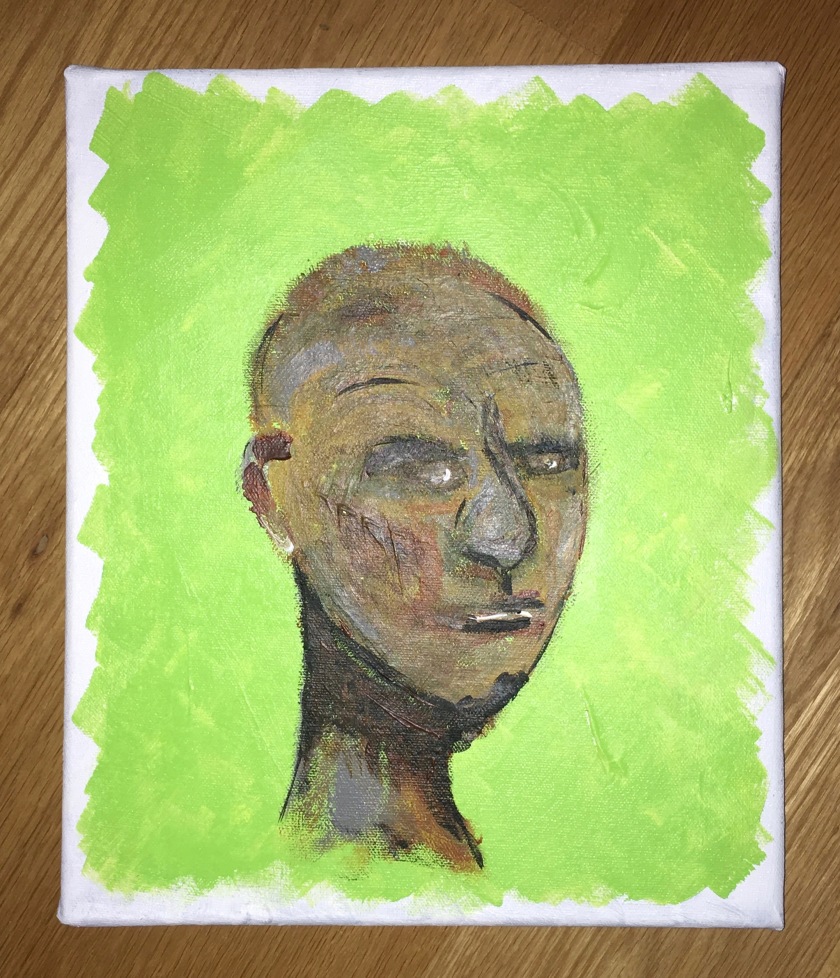
Wednesday 8th March 2017. I stood at the front of the stage, facing bright lights and about 200 people. Alongside me stood some of my art.

My friend, and conference chair Neil Usher introduced me. He said some lovely things about me, none of which I can remember!
I told the audience how nervous I was feeling. I did this as part of my coping mechanism, and also to explain that we all have a story to tell, and if I can stand there, overcome my nerves and tell my story, you can choose to do that too.
As a member of the Women’s Equality Party and with it being International Women’s Day, I felt compelled to say something about the speaker line up. I thanked Clare and Flick, the two women presenters among the line up of seventeen people, and thanked and encouraged the conference organisers to continue down this path in pursuit of a more balanced line up in future.
Introductions over, it’s time to get started. I’d been asked to deliver my session in the Pecha Kucha format. 20 slides, each one on screen for just 20 seconds. This is a tough presenting discipline, it requires a lot of planning, and distillation.
Here is a rough transcript of the talk:
What is resilience? In a search for the meaning of life, I approached Facebook and Twitter, asking, I say resilience, you say…?
I was overwhelmed with responses – almost all of them different. Too many to list and I hope to distil some in the next few minutes.
Writing in the New Yorker, Maria Konnikova says:
‘Whether you can be said to have resilience or not largely depends, on the way your life unfolds. If you are lucky enough to never experience any sort of adversity, we won’t know how resilient you are. It’s only when you’re faced with obstacles, stress, and other environmental threats that resilience, or the lack of it, emerges: Do you succumb or do you surmount?’
I take issue with this either or/binary approach – for me, part of resilience is being open to the possibilities. I use art in my consulting work because it invites inquiry, Its subjective nature helps us let go of our addiction to certainty.
The human brain holds many thoughts – let’s use more of them to nurture ourselves, and each other, in pursuit of better outcomes.
I’m going to briefly touch on my experience of resilience in relation to three important things.
- Coping with loss
- Connection and creativity
- The beauty of impermanence
In 2012 when my Dad died, after the post death rush of the funeral, I tried to get over the loss. The harder I tried the more I failed.
Elizabeth Kubler-Ross and John Kessler wrote
‘The reality is you will grieve forever. You will not get over the loss of a loved one; you will learn to live with it. You will heal and you will rebuild yourself around the loss you have suffered. You will be whole again but, you will never be the same. Nor should you be the same, nor would you want to.’
Once I grasped this, and it took years to do so, I could then appreciate I am not the same, nor do I want to be.
We need to stop telling each other to get over loss, and encourage healing and rebuilding instead.
[My friend Stephanie Barnes suggests: This feeling need not occur just around the death of a loved one, but divorce, loss of a job, sudden/unexpected change in life circumstance. They are definitely not all the same magnitude, but they do go through a similar mourning/grieving process. Mourning the life you thought you were going to have, for example.]
Tash Stallard, a dear friend, suggests that when we undertake those simple things which bring us joy – taking a walk, reading, and in my case, painting, we dissolve the need for resilience. There’s real power in this idea. I love Tash and how she thinks.
As my art develops, my need for resilience may dissolve? I slowly become more confident, with colour, shape, and texture. I start to experiment with themes, currently I’m exploring a form of elemental art. Connectedness borne of what we come from, and what we need to survive. Each element; earth, water, air, fire, is made tangible in geometric forms, using acrylic paints, gold and silver leaf. I also find the confidence to share different, emerging work with you. I rebuild resilience through experimentation, and the sharing helps strengthen connections.
In April 2016 I began to make art and give it away in my local community of Wallington and Carshalton. So far I’ve made and given away 75 art works. The connections made with my practice, with community are invaluable. The people in my home town know each other better, in part thanks to the art. And it’s not just my immediate community – I’ve left work in Australia and the USA, as well as other parts of the UK too.
I’m starting to approach the community for ideas – what should I paint this week? These exchanges, small though they are, build connectedness, and resilience among us. As my resilience grows around the project, I take on ideas I wouldn’t have dreamt of previously. I’m asked, can you paint a turtle? It would appear the answer is yes.
There’s a lot of love in and around this project.
My third observation is this. There is beauty in impermanence and imperfection, and our resilience helps us see this.
Kintsugi is the Japanese art of repairing broken pottery with lacquer containing powdered gold. As a philosophy, it treats breakage and repair as part of the history of the object, rather than something to disguise. Kintsugi pieces are prized precisely because they have been broken. The cracks you see in these pieces represents how the broken lines themselves are so beautiful, and so important, that they are rejoined with gold instead of glue.
In our lives, we often try to repair our broken places with glue. We quietly work to piece our lives back together after life-changing events, hoping that if we do a good enough job, the cracks won’t be readily visible. Sooner or later, we all carry scars, whether they be internal, external, or both. We will all break in different places, and in different ways. To me, resilience means acknowledging the beauty in those breaks, not trying to deny their existence.
But what really matters, as I learned in my search, is what’s important to you. I hope you find more of that here, today.
People responded in a lovely way, both immediately after the talk, and through the rest of the day. Yes it was a nerve racking experience, and I’m glad I did it, and I’m pleased to have been asked.